



"The world needs science, and science needs women."
(International Awards L'Oréal-UNESCO For Women in Science)
Dedicated to my mom. Her sensible advice - which remains unchanged since 2002 - encourages me to make progress towards my Master’s degree in Ecology: “Just get it done so you can (fill in the blank) go for a walk, eat dinner, watch a movie … be done with it.”
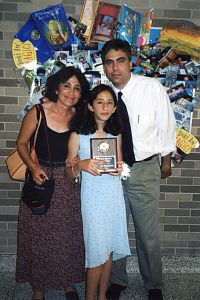 My always-supportive parents, and me, at my 5th grade graduation. I was recognized for my interest in science.
In honor of International Women’s Day on March 8th, I would like to acknowledge just a few of the influential double-X-chromosome-scientists who paved the way for this nerdy 5th grader. (Shhh, I know International Day of Women and Girls in Science was celebrated just a month ago, but this works too)!
Maybe you have heard of some of these pioneering researchers already, but likely you haven’t. I’ve included examples of women whose stories have inspired me, but also those I’ve only just learned about in writing this piece. You’ll notice a couple of central themes. For one, their work often went unnoticed and uncredited. But you’ll also notice that these women couldn’t be happier … to traverse difficult terrain, to be stranded in space, to be learning more about our Earth.
Mary Anning, Geologist
May 21st, 1799 - March 9th 1847, England
She sells seashells by the seashore.
She sells seashells by the seashore.
She sells seashells by the seashore.
Wait, who sells seashells by the seashore? Mary Anning, of course.
Mary Anning, born in 1799 in Lyme Regis, England, is known today for her significant contributions to paleontology. She is credited with finding the first Ichthyosaur to be described, finding the first skeletons of the Plesiosaurus and Dimorphodon, and pioneering the study of coprolites, or fossilized feces.
Mary’s father, Richard, was an amateur fossil collector, and when Mary was a little girl, she accompanied him on his journeys. When Richard died in 1810, Mary sold the fossils she found to help support her family.
In 1811, when Mary was only twelve, her brother, Joseph, found a large fossilized skull. Intrigued by the rare find, Mary spent months unearthing the rest of the five-meter-long skeleton. By 1820, the fossil was recognized as an extinct marine reptile and it was named the Ichthyosaur, or “fish lizard.” This 200 million year old reptile is known to science thanks to Mary’s dedication.
By the time Mary died of breast cancer in 1847, she made several significant discoveries. However, Mary was often not credited in the scientific papers that described the organisms she had found. And though the Geological Society of London honored her death, she had never been a member - women were not allowed until 1908.
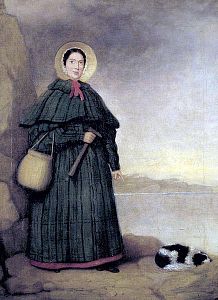 You can read more about Mary Anning from the London Natural History Museum, the Lyme Regis Museum, or the Geological Society.
Sunita Williams, Astronaut
September 19th, 1965, United States
Remember that one time your return flight was cancelled, leaving you stranded for … a day? Yeah … sorry, but not sorry about those expletives, customer service. But what if you were told that the next flight leaves in 278 days? Only, you’re not on spring break in the Azores, you’re in space.
That was the reality for Sunita Williams and Butch Wilmore aboard the International Space Station from June 5th, 2024 to March 18th, 2025. Their planned eight-day mission, turned into a 286-day journey when NASA discovered an issue with the spacecraft’s thrusters, and decided to return it with no one on board.
Sunita, born in 1965, is a retired NASA astronaut. In her 27 years with the agency, Sunita completed three space missions, logging 608 days in space, and 62 hours and 6 minutes of spacewalk - the most of any female astronaut. During her first spaceflight experience - the 14/15 Expedition - Sunita completed four spacewalks, totaling 29 hours and 17 minutes, and established a then-world record for female astronauts. During her next space mission, Expedition 32/33, Sunita performed three space walks in order to replace a part that relays power from the ISS’s solar panels, and to repair an ammonia leak in a radiator. During Expedition 72, Sunita and Butch completed a spacewalk to repair radio frequency antenna.
Now in retirement, Sunita has called her career with NASA an “incredible honor.” Oh yeah, and about that extended stay aboard the ISS, orbiting 400km above the Earth? Suni wasn’t bothered - “This is my happy place,” she said.
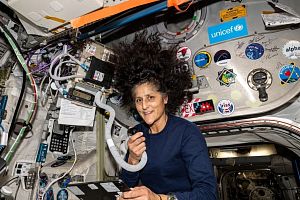 You can read more about Sunita Williams from NASA here. The New York Times wrote an inspiring piece about her resiliency here, and here you can find a NBC News report about her recent retirement.
Ynes Mexía, Botanist
May 24th, 1870 - July 12th, 1938, Mexican-American from the United States
Acourtia mexiae, Ludwigia mexiae, Ynesa colenda!
No, this is not a verse from a Latin curse (or at least, I hope it’s not). These are just a few of the 50 plant species named after intrepid botanist, Ynes Mexía, a Mexican-American woman who lived from 1870 to 1938. In just a 13-year career, Ynes collected nearly 145,000 specimens, including 600 new species of plant, and two new genera.
Ynes was born in 1870 in Washington, D.C., the daughter of a Mexican diplomat. In 1909, in her late thirties, she suffered a mental breakdown and moved to San Francisco to be treated by a psychiatrist. While there, she joined the Sierra Club and fell in love with nature. And so, in 1921 - just a year after the 19th Amendment granted American women the right to vote - Ynes enrolled as a college student at the University of California at Berkeley to study botany at the age of 51. Imagine that?
For the next 13 years, Ynes traveled - often solo - from Alaska to Tierra del Fuego, an island off the southern tip of South America, in search of rare plants. “A well-known collector and explorer stated very positively that ‘it was impossible for a woman to travel alone in Latin America,” she wrote in an unpublished paper. The journey was often dangerous; once, she accidentally ate poisonous berries.
But, Ynes was doing exactly what she wanted. After one particularly significant botanical find, she wrote, “We started on the long journey back, arriving after dark, very tired, very hot, very dirty, but very happy…”.
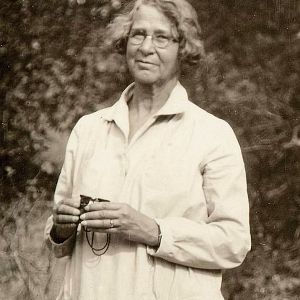 You can learn more about Ynes Mexía from the Youtube channel A World of Women in STEM here and here, from PBS American Masters, or from the National Park Service.
Now, if only one of these women could invent a time machine so I could join them on their journeys!
Some Odds n Ends:
I had the honor of seeing Jane Goodall give a speech at the Czech University of Life Sciences in 2024, just a year before her death. You can watch the speech here.
In researching this piece, I came across Dita Formánková (née Přikrylová), a Czech software engineer and the founder of Czechitas, a company dedicated to “Upskilling and Reskilling Women in IT, Cybersecurity and AI.” Check out the website here.
If you would like to learn more about influential women scientists in history, check out these resources:
- https://www.amightygirl.com/blog?p=11511
- https://www.globalcitizen.org/en/content/17-top-female-scientists-who-have-changed-the-worl/
- https://www.unwomen.org/en/news/stories/2020/2/compilation-seven-women-scientists-who-shaped-our-world
- https://awis.org/historical-women-scientists/