



A Writer Who Looked Closely at Everyday Life
When discussing Czech culture, attention often turns to major historical events or political changes. Yet much of what defines a society can be found in quieter spaces: family relationships, shared customs, and the expectations placed on women in daily life. The nineteenth-century writer Božena Němcová devoted her work to precisely these moments. Rather than focusing on grand narratives, she observed how ordinary people, especially women, lived, worked, cared for others, and shaped their communities. At a time when most published authors were men and female perspectives were rarely taken seriously, Němcová chose to write about domestic environments, village traditions, and emotional bonds. This choice was not accidental; it reflected her belief that the experiences of women and families were central to cultural identity.
Božena Němcová: A Remarkable Voice in Czech Culture
In the midst of long university readings, I try to find time to discover local authors. My Czech friend from Pilsen recommended to me something she learned in school, then re-read as an adult with a deeper perspective. Divá Bára by Božena Němcová, translated as Wild Bára. A courageous, cheerful, and independent village girl. In the twenty-first century she would’ve been Cool Bára. She was suspected to be a noon witch by the rest of the village, having an unusual behaviour. Bára had a friend, Eliška, the story serving as a depiction of powerful bonds between women who seem to be very different. Through this character, Němcová created a heroine who resists social expectations, showing that individuality and kindness can coexist even when society labels someone as “different.”
Nonetheless, Božena Němcová demonstrates through her numerous works consisting of novels, short stories, fairy tales, and legends, why her contribution remains remarkable for Czech literature. Her most popular novel, Babička (The Grandmother), alongside her collection of creations, places women and ordinary people at the centre of the narrative in the era when literature was dominated by male perspectives and elite. Writing as a woman in the 19 th century was itself an act of silent resistance, yet crucial for the recognition of women in intelligence. Němcová used her words to give visibility to situations that were often overlooked or dismissed as insignificant. At a time when women were rarely recognised as intellectual authorities, she insisted on observing, documenting, and interpreting everyday life from a female point of view. This makes her not only a literary figure, but also a cultural personality who challenged expectations simply by writing and publishing.
Reading her work today allows to connect with the lives that are at once distant and familiar, and to see how common experiences carry meaning across centuries. She highlighted the moral strength and independence of women, showing that their everyday choices and relationships shape families, communities, and even culture itself. Her stories make room for a glimpse into more personal aspects of Czech life, how people faced social pressures, celebrated small joys, and created meaning in routines.
For example, Bára is described as someone who “feared no one and walked her own path.” Rather than portraying women as passive, she showed them as emotionally intelligent, resilient, and essential to the functioning of society.
Where and how to enjoy life?
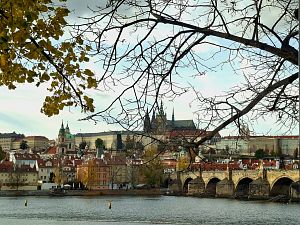
I have numerous favourite spots around the city of Prague to spend my time, with astonishing views of course. During rainy or snowy days, I find myself mostly in the Library of the Czech Academy of Sciences, just across the National Theatre. Nearby is the river Vltava, where I change locations as soon as days get sunnier and warmer. All year-round options include co-working spaces, cafes, or multi activity centres, where you can recharge with a snack. These environments reflect how culture is lived daily, not only in museums or books, but in shared spaces where students read, discuss, and exchange ideas.
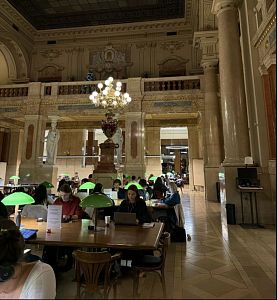 Being immersed in these communal spaces allow the imagination to wander, encourages reflection, and offers a rare moment to slow down during the hectic student life. These areas are more than just places to sit and relax. They become modern equivalents of the social environments where conversations happen, friendships form, and ideas develop. In many ways, these settings reveal the same importance of daily life that Božena Němcová captured in her writing:
places where ordinary moments shape who we are. Her stories remind us that culture is created collectively, through
relationships and everyday interactions, much like those we experience as students today. Her stories remind us that culture is created collectively, through relationships and everyday interactions, much like those we experience as students today.
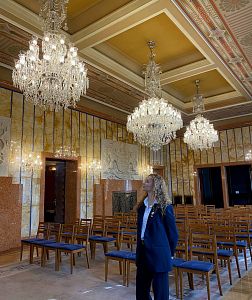
The questions about women's roles that appear in Němcová’s writing remain relevant today. In contemporary university life, dialogue about gender equality is common. There are many activities to promote women rights and opinions. Universities host discussions, workshops, and cultural events oriented on showcasing equality. The overall atmosphere feels positive, open and supportive; personally, I have not encountered negative gender-based attitudes during my studies or social interactions, nor did my friends from various parts of the world generally. The conditions make it easier to appreciate how far society has come, but there’s still work to do, and any young woman can contribute even as a fresh student. Looking back at Němcová, we can see an early example of a woman shaping public thought through creativity rather than formal power. Her legacy encourages students today to value education, expression, and empathy as tools for participation in society.
In a nutshell
Němcová’s writing reminds us that literature is not always about the extraordinary and unique. Divá Bára showcases the quiet significance and essence of Czech life as it is truly. Above all, we can hear the voices of the women who were often overlooked. Remembering her as both an author and a personality helps us understand how cultural identity is shaped not only by major historical events, but also by individuals who observe the world carefully and dare to describe it in their own voice.