



It’s 2014 and I’m standing in a small shop in Long Island City, New York - Slovak Czech Varieties. Offering products from the two countries that previously made up Czechoslovakia, they have a modest collection of Czech and Slovak books. I pick one up. I think, maybe I can identify at least one of the of words I know? Žaba, tráva, kráva, pes, brambor, opice, Akta X? I open the book. “Wtonkg woeikl kje oweiuot.” Maybe the next page? “Lkjkdgsik lksdjgls kiotwgndkjhg.” Nope - just gibberish. Am I ever going to learn this language?
Back then, the most complicated sentence I knew was, “The kráva eats the tráva.” Oh, and “Mám hlad.” - that was (is) an important one to know. I could count to ten, but not before having to repeat “čtyři” 15 times. The items in my kitchen were decorated with crudely drawn flashcards and I could say my name - “Štěpánka.” That was it.
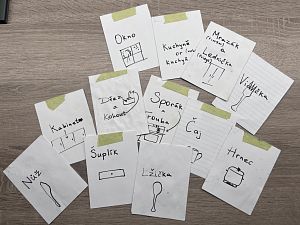 The flashcards I created circa 2016
But, in 2018, my AmeriCzech partner, Chris, and I moved to Prague. My Czech has come a long way from “The cow eats the grass.” Today I can explain my symptoms at the doctor’s office, listen to my partner and his long lost friend trade stories about their shared childhood, and advocate for myself when I’ve been charged 1,000 kč for a loofa. But, this transformation didn’t happen over night - it’s taken a lot of dedicated time, patience, effort, and money.
Are you interested in learning hezky česky? Do you also plan to make Czechia your home away from home? Read on to learn about my journey learning Czech.
Part I - Wide Eyes, Perked Ears, and a Million Questions
In the first few months of living in Czechia, I kept a tiny notebook and filled it with simple definitions and little doodles (much like Bob in Down By Law … any Tom Waits fans?). Every metro advertisement, every overheard conversation, every “co si dáte k jídlu?” was a chance to practice. My partner (who somehow had, and continues to have, endless patience) answered every one of my million questions. Soon I signed up for evening courses at Charles University. Especially in the early days of my learning, I appreciated this more traditional approach.
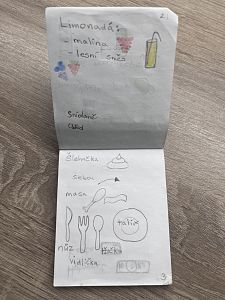 My tiny Czech doodles from my first few months living in Czechia
I was midway through my third course at Charles University when the pandemic hit. The traditional teaching style didn’t translate well online, and sitting at my laptop made me antsy.
When that course ended, I took time to learn at my own pace. I rewrote my sloppy notes into carefully penned text in a book I named “My Bible” and I listened to the spoken transcripts of blog posts written by teachers at slowczech while following along on paper.
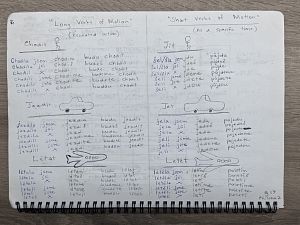 An entry in My Bible
Part II - One-on-One Online
Soon after the pandemic started, I learned about iTalki through a friend who also enjoys the process of learning languages (shout out to Haig!). On iTalki, there are thousands of teachers teaching hundreds of languages.
On my first day using iTalki, I signed up for back-to-back half-hour trial lessons - first in Italian, and then in Czech. My Italian was verrrrry rusty and I instinctively answered every yes or no question with an “ano” or “ne” (…whoops). The next lesson with Zdeni went smoothly, and I signed up for a package of ten lessons. When Zdeni and I had our first hour-long lesson, I had had so much fun I didn’t realize an hour had gone by - I legitimately thought she might be excusing herself to the bathroom when she said, “okay, I have to go now.” Zdeni is patient. Once - while relaying a funny story that had happened earlier that week - I remember thinking oh my gosh, it’s taking me FOREVER to spit this out! Can she even follow what I’m saying!? But, somehow, Zdeni did. Though she eventually went on maternity leave, Zdeni and I occasionally keep in touch, and we’ve even gone for coffee a couple of times.
Since 2022, my main teacher on iTalki has been Nicole. I admire her sense of wonder and open mindedness; in the four years that I’ve been working with her, Nicole has lived in five countries. We have spoken about every topic under the sun. Once, a while ago, we had a conversation about death rituals of the Aghori, “a Hindu monastic order of ascetic Shaivite sadhus.” The subject matter was so foreign to me, I remember thinking, Wow, I’m impressed with myself! I don’t think I’d even be confident enough to speak about this in English! Nicole is witty, and easy to talk to - in our lessons, I feel like I’m chatting with a friend.
Part III - Community
Most recently, I’ve started to venture out into the community, meeting other Czech language learners, and even living, breathing Czechs.
For instance, when a chance encounter with an old friend (shout out to Chloe!) revealed that we both have dedicated time to learning this language, we would occasionally have little “Czech Chats” through text - a unique way to reconnect after all those years. Though we’ve fallen out of practice, maybe this is a sign to start up again.
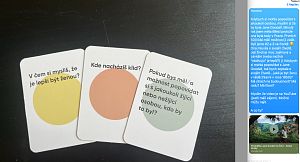 Me, listing the questions I’d ask Jane Goodall if I could
Once or twice I’ve joined meetups hosted by slowczech. Way back in around 2020, I signed up for their newsletter. There, Eliška, the founder of slowczech, often sends inspirational and thought-provoking emails. I have responded to several of these emails, and Eliška and I have had several encouraging back-and-forths.
I have also meet other Czech learners though Eliška Boušková. I first learned of Eliška through her YouTube channel, Because Czech is Cool. Somehow Eliška and I connected on LinkedIn, and this past November she invited me to bake vánoční cukroví with her and other Czech learners at her home.
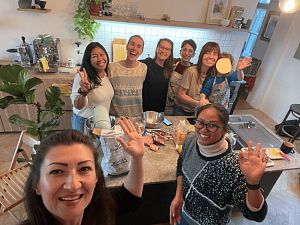 Baking Christmas cookies
A few months later, Eliška asked if I’d be interested in joining her 12 week speaking group for women. Though I had found learning on the computer to be unexciting during the pandemic, I knew this would be different. In fact, several times I actually forgot I was in a Czech lesson. In WhatsApp, we typically continued our conversation from that week’s class, shared links, stories, and pictures. We had a lot to digest - each class was like a mini-therapy session. In fact, three of the lessons - called “Masterminds” - resembled a woman’s circle more than a language lesson. During these calls, we each had time to workshop a problem - we spoke about everything from work-life balance, to uncertain futures, to feelings of helplessness in the face of societal issues like homelessness and hunger.
Eliška is laidback; she understands that learning can only happen when students are comfortable. If that means excusing yourself to make another cup of coffee, ”v klidu... žádný stres.”
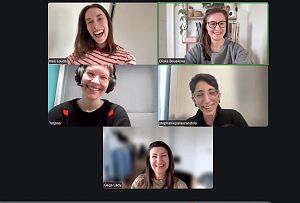 Our malá skupina
Part IV - Belonging
So, where does all of this leave me? Today, if I step outside my house, you’ll likely find me operating in Czech. I’ve taken a pottery class at a studio on the corner of my street and attended a scientific conference on the topic of my thesis. I’ve read level-appropriate books, and audited college-level courses.
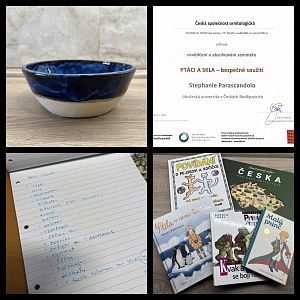 What it looks like to belong, here in Czechia
And I have bigger plans too. After a frustrating combination of trying ChatGPT, CoPilot, and PositAI in R Studio, I have (FINALLY!) created an interactive app that asks 10 random questions from the bank of 300 of the Czech Life and Institutions Exam for Czech citizenship. I made a promise to myself that the day I got the app to work, I’d sign up for the test. And so, on May 30th - likely just after this blog post is published - I will take the exam. Hold your thumbs for me!
In sum?
1. Rome (Prague) wasn’t built in a day.
When, at the small moving-up ceremony at Charles University, the more advanced students each gave a small speech, I couldn’t imagine that one day I’d get there too. But today, seven years later, the prospect of giving a presentation on my thesis topic seems like a fun challenge. This “city” was built lesson by lesson, mistake by mistake, question by question. It’s held up by the support of many teachers, family, friends, and friendly folk. It still is (and likely will always be) under construction, and that’s okay.
2. It’s okay to laugh at yourself.
Learning a new language takes a bit of humility. I’m pretty sure that once (recently) I insinuated I wanted help buying condoms instead of the adjacent lip balm because I accidentally used the first person plural form of “to want” rather than the first person singular. Another time, I told my (male) partner’s mother that my (female) fiancé was doing well (of course, I meant my sister-in-law). And how about that time I confidently stated that my birth year was 1291? I look pretty good for my age, no?
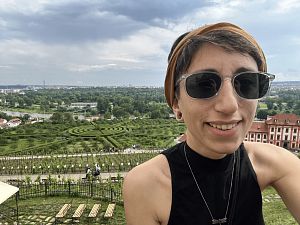 Me, at 733 years young, at the Botanical Garden in Prague
Rather than hang my head in shame, I’ve learned to find these interactions human (humorous, even), and an integral part of the learning process.
3. Get comfortable being uncomfortable.
Especially at the beginning of this journey, I spent a lot of minutes participating in conversations I didn’t understand. I’d listen, nod, smile, laugh at the occasional joke I got. Even today, sitting in a science conference, I might only crack a smile when the rest of the audience members roar in laughter. Maybe I look a bit dumb, and but I’m comfortable being uncomfortable.
Today, I wonder which book I picked up that day in 2014. Which words passages could I read now?
Hopefully this post has given you a sense of the process of learning a new language, and the many ways you can learn Czech. Are you interested in working with some of the institutions or teachers I’ve mentioned here? Reach out to them and let them know your goals! Interested in learning more about life here in general? Stay tuned for an upcoming blog post where I’ll share some of the resources that have helped me to make Czechia my home away from home.